

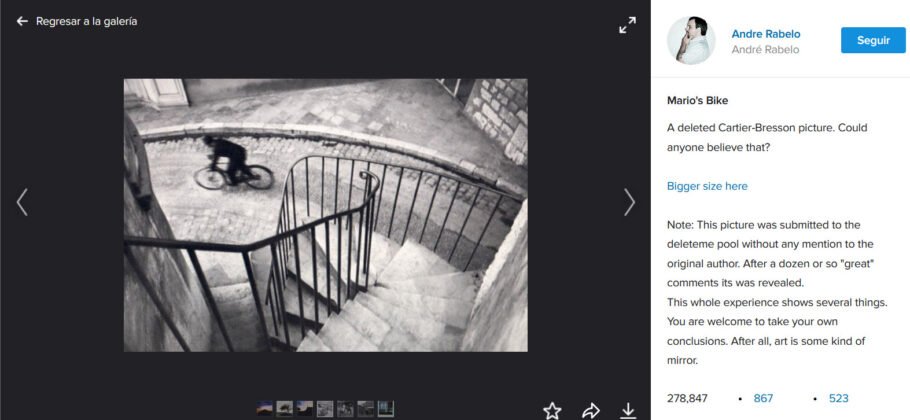
Some time ago I heard on the Instagram network a reel by the science communicator Leire Etxazarra in which she recalled a case as simple as it was revealing. The user André Rabelo uploaded to Flickr the famous photograph Hyères, France (1932), by Henri Cartier-Bresson, but did so without attributing it to its author and under the title Mario’s Bike. The image was sent to the group DeleteMe!, a space for collective critique where users voted on whether a photograph should be saved or deleted. Deprived of its signature, its historical context, and the authority of Cartier-Bresson, the image received severe criticism for its supposed blur, strange composition, or lack of sharpness.
The anecdote is usually conveyed with a somewhat mocking tone towards the less knowledgeable users of Flickr; it is tempting, but perhaps not the most fascinating. What this episode shows us is not only that some people can be mistaken when judging an image. It shows something deeper: that the valuation of art depends on interpretive frameworks. A photograph does not reach us as a bare object, but accompanied by a name, a story, an institution, a price, a critical tradition, and an expectation of value. When all of that is removed, even a canonical image can once again appear as a mere photograph.
The image before the myth
Hyères belongs to the moment when Cartier-Bresson had just discovered the possibilities of the Leica and began to shift photography towards a more agile relationship with the street. Magnum recalls that in 1932, after his stay in Ivory Coast, the photographer discovered the 35 mm camera and began a decisive relationship with the medium. The Metropolitan Museum of Art also emphasizes that in those years his gaze was influenced by Cubism and Surrealism. Therefore, we are not facing an image born already as a monument, but an early photograph taken during a period when the photographic language itself was negotiating its artistic authority.
The scene is minimal; from an elevated point, the staircase occupies the foreground and leads the gaze towards a curved street. A cyclist passes through the frame, slightly blurred, without becoming a portrait or psychological protagonist. The photograph works because it unites two different times: the stable time of architecture and the fleeting time of movement. The staircase, the curves of the street, the railing, and the shadows prepare the space; the cyclist activates it.
There lies its ambiguity: if the image had been only a geometric composition, it would have been close to formalism. If it had been only the quick capture of a cyclist, it would have exhausted itself in anecdote. Its strength arises from the union between an organized background and an unrepeatable event. The history of its valuation will consist precisely in deciding whether that coincidence should be read as luck or as method.
From anti-graphic photography to the decisive moment
The first important public framework came in 1933, when Cartier-Bresson presented at the Julien Levy Gallery in New York an exhibition titled Anti-Graphic Photography, Photographs by Henri Cartier-Bresson. The label did not mean absence of form, but an opposition to photography understood as a precious finish, salon composition, or laboratory manipulation. In that environment, close to Surrealism, chance and the fortuitous were not defects: they were ways to open the image to the unexpected.

From that perspective, Hyères could be seen as a fortunate anomaly. The composition was too precise to go unnoticed, but the interpretive framework was not yet fully prepared to turn that precision into a doctrine. The photograph seemed to say: the photographer was there when something happened. Only later would it say something else: the photographer had constructed the frame so that what happened could become form.
That shift was consolidated in 1952 with the publication of Images à la sauvette in France and The Decisive Moment in the United States.
The book not only gathered images; it taught how to read them.
By formulating photography as the simultaneous recognition of the significance of an event and the formal organization that expresses it, Cartier-Bresson offered a retrospective key to understand his early work. Hyères then ceased to be a surprising image to become the visual proof of a theory.
The museum and the market as consolidation of the context
Museum incorporation completed that transformation. The MoMA preserves “Hyères, France” as a silver gelatin print made in the 1930s, with object number 42.1942. The acquisition date (1942) is important because it shows that the image entered a modern collection early, even before the editorial consecration of 1952. Later it appeared in exhibitions such as Five French Photographers, Photographs from the Museum Collection, 50 Photographs by 50 Photographers, and Henri Cartier-Bresson: The Modern Century.
A work acquired, preserved, exhibited, and re-exhibited by a reference museum ceases to depend solely on the immediate reaction of the viewer; it enters a regime of memory. It is assigned an inventory number, its measurements are documented, it is related to a collection, included in retrospectives, and made available to teachers, critics, and visitors. All these operations seem administrative, but they are also aesthetic: they help decide which images deserve to be remembered as singular exemplars.
The market comes later, although not independently. In a Phillips auction, a print of “Hyères, France” estimated between 12,000 and 18,000 dollars reached a hammer price of 100,000 dollars. This data does not mean that the price explains the quality of the photograph, but something more precise: that the market translates into economic value a narrative that has already been stabilized by books, museums, exhibitions, and collectors.
The value of the frame
The story of Hyères aligns well with what neuroscience has studied as the framing effect. One of the most cited works in this field is by Kirk, Skov, Hulme, Christensen, and Zeki, published in NeuroImage in 2009. The researchers showed participants abstract works inside an fMRI scanner but manipulated the contextual label: sometimes the images appeared as coming from a gallery; other times, as computer-generated. They were the same images, but the judgment changed. Works labeled as coming from a gallery received a higher aesthetic rating, and this modulation was related to activity in prefrontal and orbitofrontal regions associated with value evaluation.

Something similar appears in the study by Huang, Bridge, Kemp, and Parker on Rembrandt portraits, published in Frontiers in Human Neuroscience in 2011. Participants observed authentic works and copies but were given an indication beforehand about whether they were facing an authentic or fake piece. The authenticity label did not act as mere external information: it modified the way the brain organized attention. The image remained visually the same, but the frame altered the experience.
This does not mean that all artistic judgment is pure suggestion; it means that we do not see only with our eyes. We also see with expectations, names, narratives, and learned hierarchies. That is why Rabelo’s case with Mario’s Bike is so effective: by removing Cartier-Bresson’s name, the image temporarily loses the frame that taught us to see it as a masterpiece.
Other experiments with authority
Art has often tested this dependence on context. In 2013, Banksy set up a street stall in Central Park where an anonymous vendor offered original canvases signed for 60 dollars. The works were authentic, but the public treated them as street merchandise. According to coverage of that episode, the total sales of the day barely reached 420 dollars. The visual object had not changed; what was missing was the gallery frame, the expectation of scarcity, and the announcement of authorship.
The well-known experiment by the Washington Post with Joshua Bell is also often cited. In 2007, the violinist played incognito in the Washington D.C. metro with a Stradivarius of considerable value. In a concert hall, his presence activates a listening disposition; in a metro station, that same quality is absorbed by haste, noise, and lack of expectation. The context does not add beauty from outside but creates or destroys the conditions for that beauty to be perceived.

The collective MSCHF took this logic to the extreme in 2021 with Museum of Forgeries. After acquiring a drawing by Andy Warhol, Fairies, they produced 999 copies and mixed the original among them, selling the thousand copies as Possibly Real Copy Of ‘Fairies’ by Andy Warhol. The operation showed that when authenticity can no longer be located, the value associated with the original dissolves. The work continued to exist, but its position within the attribution system was deliberately sabotaged.
A learned convention
Hyères is today easily recognizable as a great photograph because we have learned to recognize certain signs of photographic greatness: the suspension of a gesture, the integration of the subject into a geometric structure, economy of means, the appearance of spontaneity, and the absence of visible manipulation. But these criteria are not natural; they are historical conventions formed by schools, museums, books, critics, markets, and communicators.
That is why it is advisable to speak of value construction and not only compositional genius. Hyères circulates as an image but also as a case: a case of anti-graphic style, a case of the decisive moment, a case of street photography, a case of museum canon, a case of market, and now also a case of contextual bias on social networks. The accumulation of these layers does not annul the initial visual experience; it consolidates it. Whoever looks at the photograph today does not see just a cyclist in Hyères; they see a history of legitimization deposited upon that cyclist.
The image did not go unnoticed because it lacked power, but because its power needed a grammar. Once that grammar was consolidated, chance ceased to be understood as accident and began to function as an index of mastery. Not just any chance, but that which the photographer knew how to wait for, frame, and turn into form.
Conclusion
The value of art does not reside solely in composition nor solely in context. It appears in the relationship between both. Hyères possesses an extraordinary visual construction, but that construction needed a frame to be recognized as such: first the surrealist and “anti-graphic” environment, then the concept of the “decisive moment,” later the museum, editorial history, the market, and, of course, modern social networks.
The Flickr episode does not destroy Cartier-Bresson’s greatness; it reminds us that the gaze is not innocent, that authority modifies perception, and that many times we learn to see after having learned to value. Perhaps that is why Hyères remains so useful: because it not only shows a bicycle passing through a street but the way a visual culture learns to turn a moment into cultural heritage.
Continued in the article “The rule of thirds is a lie, but AI does not know it“
Sources consulted
- Rabelo, André. “Mario’s Bike”. Flickr.
- Fondation Henri Cartier-Bresson. “Exhibitions“.
- Fondation Henri Cartier-Bresson. “Henri Cartier-Bresson, Images à la sauvette / The Decisive Moment“.
- Fondation Henri Cartier-Bresson. “Manuel Alvarez Bravo, Henri Cartier-Bresson et Walker Evanss”.
- The Museum of Modern Art. “Henri Cartier-Bresson. Hyères, France. 1932“.
- The Metropolitan Museum of Art. “Henri Cartier-Bresson: Hyères, France“.
- Phillips. “Henri Cartier-Bresson, Hyères, France“.
- Magnum Photos. “Henri Cartier-Bresson“.
- Kirk, U.; Skov, M.; Hulme, O.; Christensen, M. S.; Zeki, S. “Modulation of aesthetic value by semantic context: An fMRI study“. NeuroImage, 44(3), 1125-1132, 2009. DOI: 10.1016/j.neuroimage.2008.10.009.
- Huang, M.; Bridge, H.; Kemp, M.; Parker, A. “Human cortical activity evoked by the assignment of authenticity when viewing works of art“. Frontiers in Human Neuroscience, 5, 134, 2011. DOI: 10.3389/fnhum.2011.00134.
- CBS News. “Banksy sells art works for $60 in New York’s Central Park“. October 14, 2013.
- The Washington Post. “Joshua Bell’s Metro encore draws a crowd“. September 30, 2014.
- Swissinfo / AFP. “Buying a Warhol to destroy it among 999 copies“. October 27, 2021.