

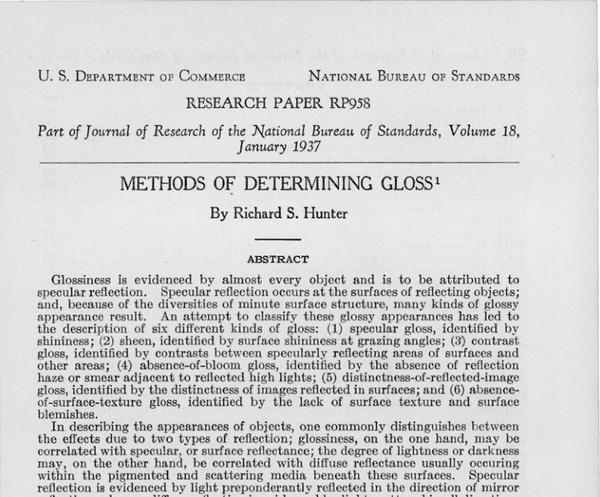
The article “Methods of Determining Gloss” by Richard S. Hunter, published in 1937 in the Journal of Research of the National Bureau of Standards, addresses the complex task of quantifying the gloss of surfaces. Hunter highlights that gloss is an optical property inherent to many surfaces and is perceived due to specular reflection. However, the methods to measure it are varied and not always precise, due to the difficulty of completely separating specular reflection from diffuse reflection.
Hunter classifies gloss into six distinct types, each identified by specific observable characteristics:
1. Specular gloss, related to the shiny appearance of a surface.
2. Sheen, perceived at grazing angles.
3. Contrast gloss, determined by the contrast between specularly reflective areas and non-reflective areas.
4. Gloss by absence of haze, identified by the absence of diffuse reflections adjacent to points of high illumination.
5. Gloss by sharpness of the reflected image, which depends on the clarity of images reflected by a surface.
6. Gloss by absence of surface texture, which is associated with the lack of visible texture on a surface.
Hunter’s thorough analysis reveals that, to describe and measure gloss, it is crucial to consider the directional distribution of reflected light under specific lighting conditions. However, these goniophotometric data are complex and cumbersome, which has led to the development of gloss measurement devices based on simpler empirical means. These devices often measure gloss specifically for certain types of materials, using reference standards calibrated with apparent reflectance.
Hunter suggests that designers of gloss measurement instruments should rely on goniophotometric data to identify which reflectance differences are most characteristic of variations in visually observed gloss. Thus, the design of gloss meters could be further reduced to trial and error by using these data to indicate the most relevant reflectance measurements for different purposes.
Different types of gloss measurement instruments are described, such as the Ingersoll glarimeter and the Pfund gloss meter, each adapted to measure specific types of gloss, from specular gloss to contrast gloss or sharpness of the reflected image. Measurements with these instruments must be carried out with precise indications regarding the directions and apertures of incidence and viewing, as well as the spectral composition and polarization of the light used.
In summary, Hunter’s article not only classifies and describes the different types of gloss but also provides a methodological guide for its measurement, emphasizing the importance of goniophotometric data and the need for precisely designed measurement instruments to correlate visual gloss assessments with quantitative metrics.