


In recent times it is difficult not to come across some course, magazine, or introductory publication on photography that does not engage in a certain indoctrination about the composition rules related to the almost omnipresent concept of the “rule of thirds.” Because of this, the “grid” has been introduced in the vast majority of cameras as an additional assistant to help us capture brilliant photographs.
Editorial update (2026). This article, originally published in 2015, introduces the comparison between the rule of thirds and the golden ratio. Subsequent works published on this website expand and correct some of its conclusions: the rule of thirds does not geometrically derive from the golden ratio, and the presence of the latter alone does not explain the aesthetic quality of a photograph.
For further reading, you may consult “The rule of thirds is a lie, but AI doesn’t know it” and “The golden ratio does not explain your photographs”.
Personally, one often hears the justification of the rule of thirds based on the golden ratio, also known as the “golden number,” “golden mean,” or even “divine proportion,” which has been a widely referenced concept in mathematics since Euclid encountered this value.
Without delving into excessive mathematical reasoning, the golden number is commonly described by the value Phi (φ), which is equivalent to 1.6. That is, a perfect rectangle given by sides a and b will have a golden ratio if a/b=1.6.
Another concept closely related to the golden number is the golden spiral, whose growth factor is determined by φ. The golden spiral is often associated with the Fibonacci series, which generates a spiral very close to the golden spiral.
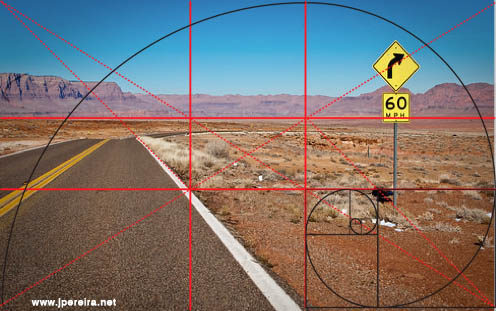
However, when we want to transfer the concept and/or golden ratio to digital photography, dominated by the 35mm frame size (36x24mm) with an aspect ratio of 3:2, or equivalently a/b=1.5, it is directly impractical to apply a golden composition to this format without performing a subsequent crop.
According to what I can read in an interesting discussion about the origin of the rule of thirds on photo.net, the origin of this compositional rule seems somewhat uncertain throughout the literature associated with photography as a discipline itself.

According to the book “Chromatics; or, The analogy, harmony, and philosophy of colours” by George Field from 1845 (information obtained from Wikipedia), it seems that the origin of the rule of thirds may lie with the painter Joshua Reynolds, who proposed it as a compositional strategy at the level of color treatment, and shortly thereafter John Thomas Smith adopted it as a more general rule.
However, despite finding references inherited from painting, in photography there do not seem to be many references in the classical literature of the early and mid-19th century. It is also not easy to find a sensible geometric reasoning for the rule of thirds, except for the ease of dividing a grid with a 3:2 ratio into 9 equal parts, in order to facilitate our perception system to organize parts of a scene simply.

Similarly, it is not easy to relate the rule of thirds to the golden ratio beyond a simple generalization or simplification of the golden ratio aimed at facilitating the teaching of composition. In fact, there are professionals in this field with long experience who affirm that the rule of thirds is a concept popularized recently (in the last decade) as a simplification of golden ratios within an amateur context. As we can see in the image on the left, the grid or regions related to the rule of thirds approximate but do not correspond to the golden ratio.
Conclusions: a comparison, not an equivalence

The rule of thirds continues to be a useful resource for organizing a scene and for beginning the study of composition. However, it is not a universal law of perception nor a guarantee that a photograph will work aesthetically.
The rule of thirds and the golden ratio are distinct geometric systems. Although their grids may appear close in some compositions, there is no direct geometric derivation that allows one to be presented as a simplification of the other. Therefore, it is advisable to use them as observation tools and not as automatic explanations of image quality.
This article is preserved as an introduction to the comparison between both resources. For a more extensive historical, cultural, and methodological review, continue with the texts linked below.
Continue reading: updated research
This reading path develops the two issues initially raised here:
- The rule of thirds is a lie, but AI doesn’t know it: reviews the historical origin of the rule, its conversion into a pedagogical convention, and its persistence in cameras, software, and artificial intelligence.
- The golden ratio does not explain your photographs: examines the limits of the golden ratio as an aesthetic explanation and the distance between a geometric template and the visual experience.
Read together, the three articles propose the same idea: grids can help to look and teach, but they do not replace image analysis, its context, or the experience of the observer.