


Infrared fluorescence is a luminescence phenomenon of certain materials, whereby after excitation in specific bands of the visible spectrum, an emission in the form of fluorescence occurs in the infrared region, usually in the VNIR.
Contrary to what happens with ultraviolet fluorescence, where excitation occurs in the visible region, and after a Stokes shift energy is emitted in the visible range. In the case of infrared fluorescence, excitation occurs in the visible and emission in the infrared.
In the study of artworks and cultural heritage in general, infrared fluorescence gained special relevance with the discovery of the luminescent qualities of Egyptian Blue or calcium copper silicate present in the mineral Cuprorivaite. However, due to the scarcity of this mineral, Egyptian Blue is proposed as one of the first synthetic pigments in human history. Egyptian Blue can be induced to luminesce when excited around 600 nm, producing an emission around 900 nm.
 There are other historical pigments such as certain cadmium derivatives that can also exhibit infrared fluorescence. However, as with UV fluorescence, there are numerous variants that may cause a compound to either exhibit or not exhibit luminescence.
Infrared fluorescence is also present in nature in the chlorophyll of plants.
Another widely extended application of infrared fluorescence is its use in the field of document examination, both from the perspective of forensic sciences and cultural heritage. Since the faint fluorescence that some inks may exhibit serves as a contrast with substrates or other inks, creating a differentiating criterion between compounds, or simply improving their perception.
 Certain inks exhibit luminescence phenomena, allowing their rapid differentiation from others, as well as the enhancement of faded strokes caused by damage or aging of the document. It is even possible to take advantage of the cellulose fibers’ own absorption of IR, thanks to transmitted light, to detect by transmission the contrast produced with respect to the ink.
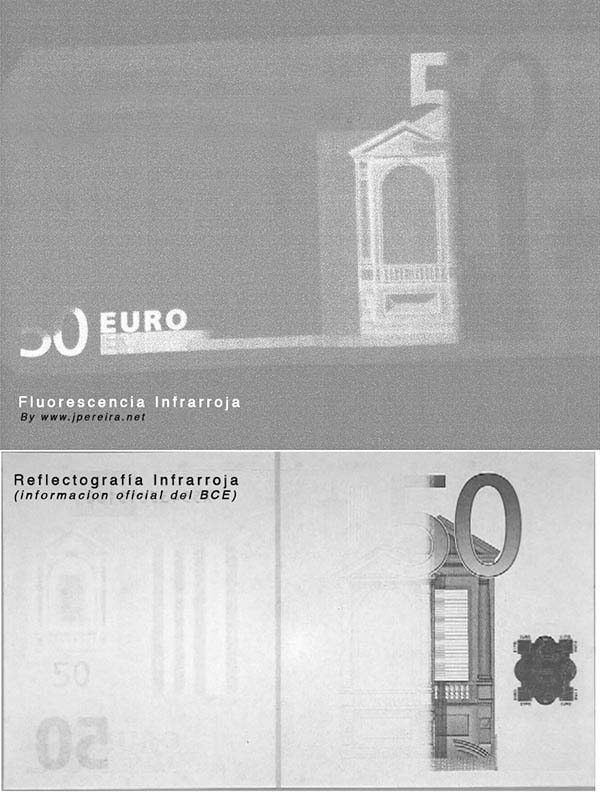
Finally, infrared fluorescence is widely used as a security marker in legal documents and even currency. On the left, we can see a comparison between the infrared reflectography of a 50 Euro banknote; at the top, an infrared near fluorescence phenomenon can be seen as a security element to prevent counterfeiting. In the case of the Euro currency, this hidden marker does not seem to be publicly recognized by the ECB itself, so it could be among the undeclared measures to prevent extremely precise counterfeiting.
However, for our case, having these fluorescent markers in everyday elements of our lives helps us calibrate capture systems, thus avoiding false positives due to poor execution of a technique.
If you want to learn more about the different forensic inspection or document examination techniques in currency, you can visit the following article “Reflectance, Absorbance and Transmittance in Banknote Security”