

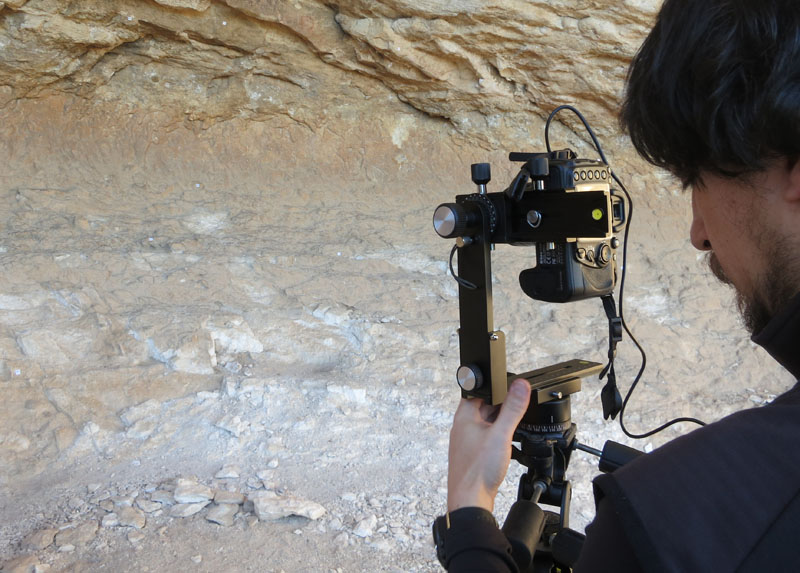
Although the world of panoramas in the field of graphic heritage documentation, or scientific photography, is somewhat delicate due to the aberrations that can accumulate depending on the chosen projection, type of lens, field of view covered, etc., it remains an extremely useful technique for covering wide scenes or achieving images with a very high degree of detail.
This brief article will address the fundamentals of the calculations that will allow us to deduce the rotation angles of our panoramic heads so that once in the field we know how to configure them to cover the entire scene.
Panoramic heads, in addition to those designed to rotate the camera around the entrance pupil, or so-called nodal point, are equipped with a horizontal rotation system and a vertical one, in order to be able to move our camera along the X and Y axes, which will allow us to cover more or less wide scenes.
To effectively cover our entire scene, we must know how many degrees to rotate the camera and how many steps to take to cover the entire space. Empirically, we can do this by controlling the overlap through the viewfinder of our camera, but the most appropriate approach is to plan the scene a bit, which can save headaches, especially if we need to make more than one row to cover a greater vertical angle.
The basis of all these calculations lies in the formula for the field of view or FOV (Field Of View):
FOV = 2*arctan (d / 2f)
Where d is the sensor dimension along the axis on which we will operate and f is the focal length of our lens.
As input data, we must know the dimensions of our camera’s sensor; for example, in my Nikon D200 I have a typical Nikon APS sensor of 23.6 x 15.8mm. Thus, the horizontal field of view of my camera with a 35mm lens will be given by:
FOV = 2*arctan(23.6 / 2*35) = 37.3º
Similarly, the vertical field of view of my sensor will be:
FOV = 2*arctan(15.8 / 2*35) = 25.4º
With this data, if we wanted to cover an area of 180º with our camera in “portrait” position, we would need to shoot:
180 / 25.4 = 7 photos
However, this would not be correct since there would be no overlap between images and the image stitching tool would not be able to create the panorama. For this, it is necessary to determine a percentage of overlap between images, which, for example, could be 25%. Thus, we must adjust our field of view according to this percentage, so we get:
(25.4 * 25) / 100 = 6.35%
FOV’ = 25.4 - 6.35 = 19º
180º / 19º = 9.4 photos
So now, instead of 7 photos, we would need to shoot 9, since we have discounted the overlap in the native FOV of our equipment.
With this information, we already know that to safely create a 180º panorama, we will take 10 photos rotating the camera in 19º steps.
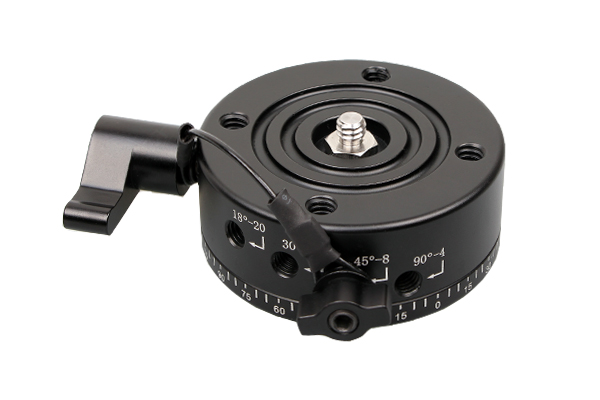 However, there is another concept which is the rotation steps of our panoramic heads. Most panoramic heads or systems incorporate “steps” that, like indicators, notify us with a small click the jump between steps.
Depending on the quality and models, we will have various rotation scales, for example, it is common to find the following steps: 5,10,15,20,24,30,36,45,60,90, which would indicate that our head has indicators every 5º, 10º, etc. Other more economical heads only notify us every 15º or 24º, etc. This does not imply that the head cannot move every degree, simply that the rotation calculation must be done on the scale of the head and is more cumbersome.
Thus, if in our calculations we have obtained that the camera must be rotated every 19º and our head probably does not have that indicator, we will do it every 20º or, failing that, every 15º, although, obviously, the overlap area will be much larger.
The same happens with vertical rotation; with our camera in “portrait” format, the vertical angle covered is 25.4º. If we need to cover more than this area, we would return to the previous method, dividing the vertical coverage by the sensor height minus the % of overlap.
To visually exemplify these calculations, I have designed a small online panorama calculator that allows us to draw mosaics, shooting sequences, and rotations of our panoramas based on a sensor type, focal length, and area to cover.